What is LLM Compressor?
LLM Compressor is an easy-to-use library for optimizing large language models for deployment with vLLM. It provides a comprehensive toolkit for applying state-of-the-art compression algorithms to reduce model size, lower hardware requirements, and improve inference performance.
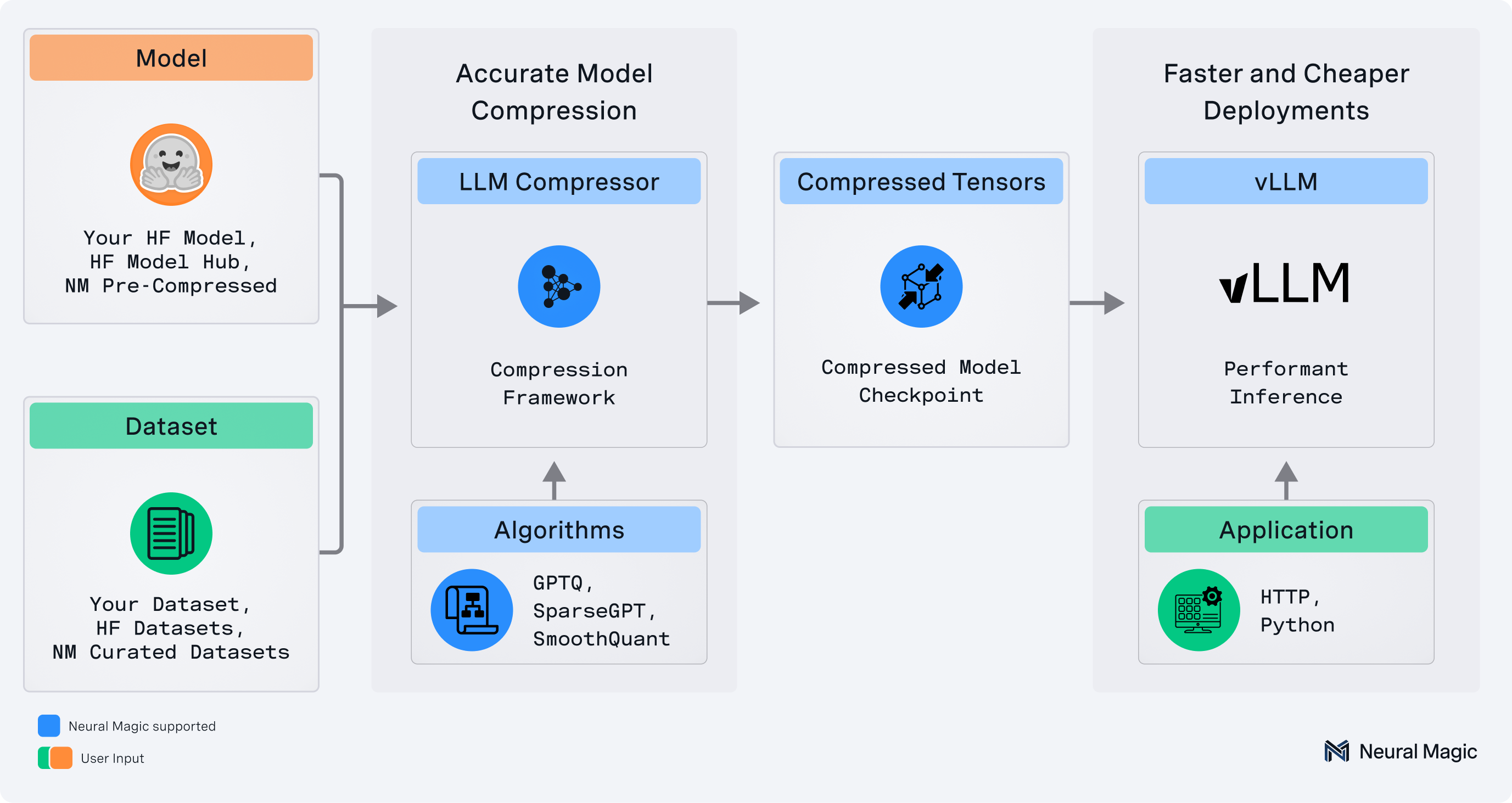
Which challenges does LLM Compressor address?
Model optimization through quantization and pruning addresses the key challenges of deploying AI at scale:
| Challenge | How LLM Compressor helps |
|---|---|
| GPU and infrastructure costs | Reduces memory requirements by 50-75%, enabling deployment on fewer GPUs |
| Response latency | Reduces data movement overhead because quantized weights load faster |
| Request throughput | Utilizes lower-precision tensor cores for faster computation |
| Energy consumption | Smaller models consume less power during inference |
For more information, see Why use LLM Compressor?
New in this release
Review the LLM Compressor v0.13.0 release notes for details about new features. New features to be aware of include:
-
REAP Expert Pruning: New modifier for structurally pruning Mixture-of-Experts (MoE) models by removing individual experts based on calibration-based saliency scores. Based on the REAP the Experts paper.
-
Arbitrary Bit-Width Quantization (Humming): Dense packing for non-power-of-2 bit widths (3, 5, 6, 7) with no wasted bits, plus 16 new WxAy presets covering W2–W8 weights with A4, A8, or A16 activations.
-
Observer Fusion and Deletion: Refactored observer lifecycle and significantly reduced memory usage for large models due to observer statistics persisting after calibration.
-
Expanded MoE Architecture Support: Extended MoE linearization to support a broader range of architectures
-
Improved XPU Compatibility: Migrated torch.cuda calls to torch.accelerator for Intel XPU support.
Supported algorithms and techniques
| Algorithm | Description | Use Case |
|---|---|---|
| RTN (Round-to-Nearest) | Fast baseline quantization | Quick compression with minimal setup |
| GPTQ | Weighted quantization with calibration | High-accuracy 4 and 8 bit weight quantization |
| AWQ | Activation-aware weight quantization | Preserves accuracy for important weights |
| SmoothQuant | Outlier handling for W8A8 | Improved activation quantization |
| SpinQuant | Rotation-based transforms | Improved low-bit accuracy |
| QuIP | Incoherence processing | Advanced quantization preprocessing |
| FP8 KV Cache | KV cache quantization | Long context inference on Hopper-class and newer GPUs |
| AutoRound | Optimizes rounding and clipping ranges via sign-gradient descent | Broad compatibility |
Supported quantization schemes
LLM Compressor supports applying multiple formats in a given model.
| Format | Targets | Compute Capability | Use Case |
|---|---|---|---|
| W4A16/W8A16 | Weights | 7.5 (Turing and up) | Optimize for latency on older hardware |
| W8A8-INT8 | Weights and activations | 7.5 (Turing and up) | Balanced performance and compatibility |
| W8A8-FP8 | Weights and activations | 8.9 (Ada Lovelace and up) | High throughput on modern GPUs |
| MXFP8 | Weights and activations | 10.0 (Blackwell) | Microscale FP8 |
| NVFP4/MXFP4 | Weights and activations | 10.0 (Blackwell) | Maximum compression on latest hardware |
| NVFP4A16/MXFP4A16/MXFP8A16 | Weights | 7.5 (Turing and up) | Weight-only microscale compression |
| W4AFP8 | Weights and activations | 9.0 (Hopper and up) | Low-bit weights with dynamic FP8 activations |
| W4AINT8 | Weights and activations | — (Arm CPU) | Low-bit weights with dynamic INT8 activations |
Warning
Sparse compression (including 2of4 sparsity) is no longer supported by LLM Compressor due to lack of hardware support and user interest. Please see https://github.com/vllm-project/vllm/pull/36799 for more information.